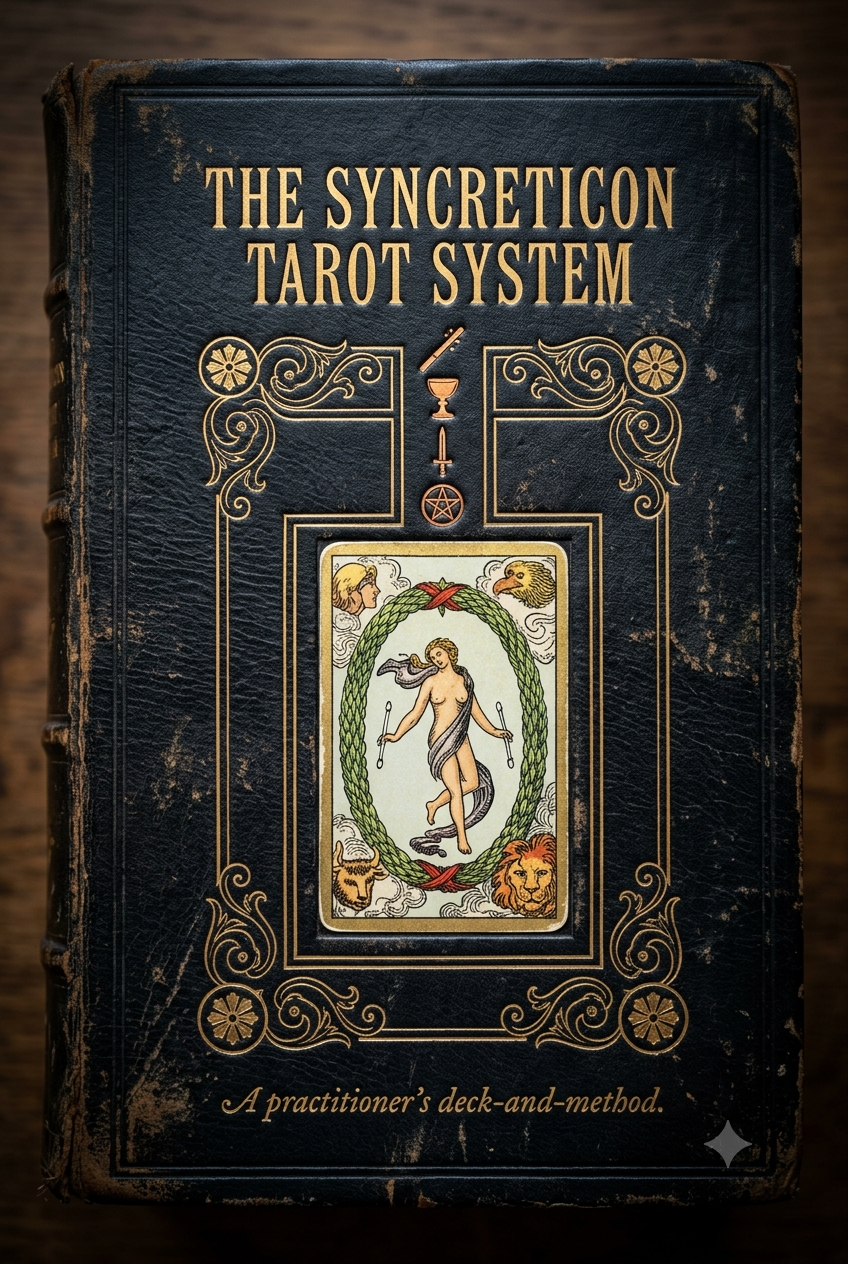
There are many books on the Tarot. Some are old, some are new, some are better than others. You have chosen this one — perhaps deliberately, perhaps by a drift that you would not quite call a choice. Either way, the cards you hold (or have not yet held) are already asking you something. This book is a long answer.
The Tarot is not difficult. It is not, as some have suggested, a secret doctrine accessible only to initiates. The seventy-eight cards are a set of pictures. The pictures carry meanings. The meanings combine in conversation with one another according to position and neighbour, and the combination tells a reader something useful. That is the whole of it. The difficulty is not in the Tarot — the difficulty is in becoming the sort of reader the Tarot can speak through. That is what the rest of this book concerns.
You will have heard it said that the cards predict the future. They do not, in any straightforward sense. What they do is more interesting. They show you the shape of the present moment so clearly that the future — or, rather, the likeliest trajectory out of the present — becomes visible without further magic. The Tarot is a lens; it is not a telescope. It does not see what is over the hill. It lets you see what you are standing in, and what you are standing in turns out to contain most of what was going to happen anyway.
This is therefore a book about reading the present. If you wanted a book of prophecy, set this one down. The Syncreticon Tarot System does not do prophecy. It does, at its best, something more useful: it teaches the reader to see their own life without the blur that hope and fear usually put over the glass.
There is a long tradition behind the Tarot, and this book names some of it. There are systems of correspondence — letters, numbers, elements, planets, paths — that thread through the cards, and this book describes them. But the book is not about correspondences. It is about reading. You could know every correspondence and still be unable to read a card well. You could know almost none of them and read cards beautifully. The correspondences are scaffolding. They help you remember the meanings and hold them in relation. Once the meanings are in you — in the body, not just the head — the scaffolding can fall away and the cards will simply speak.
The book is laid out in parts. The first part gives you the tradition: where the cards came from (as best it can be told), what they are in themselves, and how the deck is structured. The second part walks every card — the twenty-two Majors first, then the four suits, then the forty numbered pips and the sixteen courts. The third part teaches you symbolism: the elements, the numbers, the colours, the many small creatures and objects that appear in the cards. The fourth part teaches you how to read — the question, the spread, the interpretation, the judgement of what a card is saying in its particular place. The fifth part addresses time: when the cards open, when they fall silent, and why. The sixth teaches meditation and inner work with the cards — the slow and deeper uses that have nothing to do with asking questions and receiving answers. The seventh teaches you how to design your own deck, how to give a card a new voice, and how to memorise the seventy-eight so they live in the body rather than on a cheat-sheet.