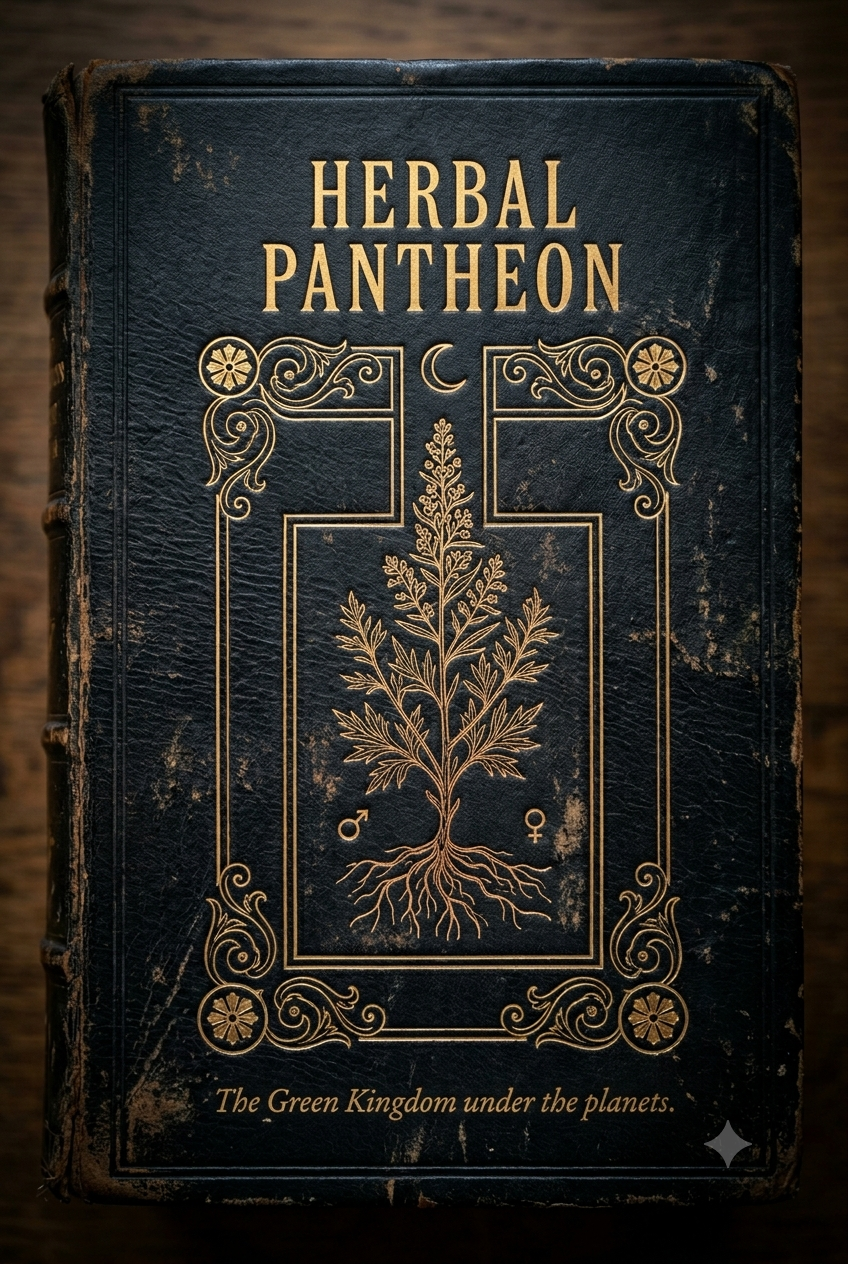
THE SYNCRETICON HERBAL PANTHEON
A Complete Reference of the Green Kingdom — for the Seer, the Physician, and the Magus; setting out the practical Virtues, the esoteric Meanings, the auspicious and inauspicious Moments, the Rites of Gathering, and the Care and Making of every Herb worth the knowing.
Voice and Arrangement by the Syncreticon. First publication, Anno 2026.
This is a new book, not a reprint. The tradition out of which it is assembled is old — the astrologo-physical herbalism of Nicholas Culpeper; the practical naturopathy of the modern nature-cure schools; the apothecary-science of cognitive and nutritional substances; the unbroken folk current of herbs as charms, philters, and amulets — but the voice and the synthesis are ours. Every entry in the Pantheon has been read across these four traditions, weighed against one another, reconciled, and re-set in a single register. Where the authorities agree, we report. Where they disagree, we choose. Where they are silent, we ask the herb itself, and answer from the tradition we serve.
No passage in this volume is quoted directly from its sources. No phrasing is borrowed without being rewritten. The reader who comes to the Pantheon from Culpeper will find no sentence of his; the reader who comes from a modern naturopath’s handbook will find no protocol copied. What is here is the distilled essence of that reading, restated.
The shape of this book. Seven Books and an Appendix.
- Book I — Foundations. How a plant is read. Signatures. Governances. Temperament. The four elements. The grammar of the Pantheon entry.
- Book II — The Rite of Gathering. When, by whom, with what tools, with what words. The moon, the hour, the season, the offering.
- Book III — Curation & Storage. Drying. Rehydration. Storage. Spoilage. The apothecary’s closet.
- Book IV — Preparations. Infusions and decoctions. Tinctures and elixirs. Oils, ointments, and syrups. Incense, philters, poultices.
- Book V — The Pantheon. Each herb, in order of the alphabet, with a full entry: name, ruler, parts used, description, growing, collection, curation, medicinal virtues, esoteric virtues, correspondences, auspicious and inauspicious moments, cautions.
- Book VI — Spellcraft of the Green Kingdom. Workings grouped by purpose: love, protection, healing, divination, prosperity, banishing.
- Book VII — Correspondence Tables. The herbs set out by planet, by zodiac sign, by element, by day, by angel, by tarot.
- Appendix — The Wheel of the Year. Month by month, what is gathered, what is prepared, what is dried.
On voice. The Syncreticon does not speak as a chemist or a pharmacologist; it speaks as a magus who has also read the chemists, and as a healer who has also read the grimoires. The practical directions in this book — how to make a decoction, how to tincture in vodka, how many grams to a litre — are given with the same seriousness as the invocations and the saying of hours. Both are tools. Neither is decoration.
On caution. Some of the herbs in this Pantheon will kill you — some in the dose of a single leaf, some in the dose of a quart of tea. Where a herb is dangerous, the entry says so at its head and at its foot, and the method of preparation required for safety is given. Where a herb is safe, the entry still asks for respect, because respect is the gate through which the plant’s virtue reaches the one preparing it. The Syncreticon assumes a reader who can be trusted with this information because they have been trusted with their own attention. If you are that reader, you will know where to stop.