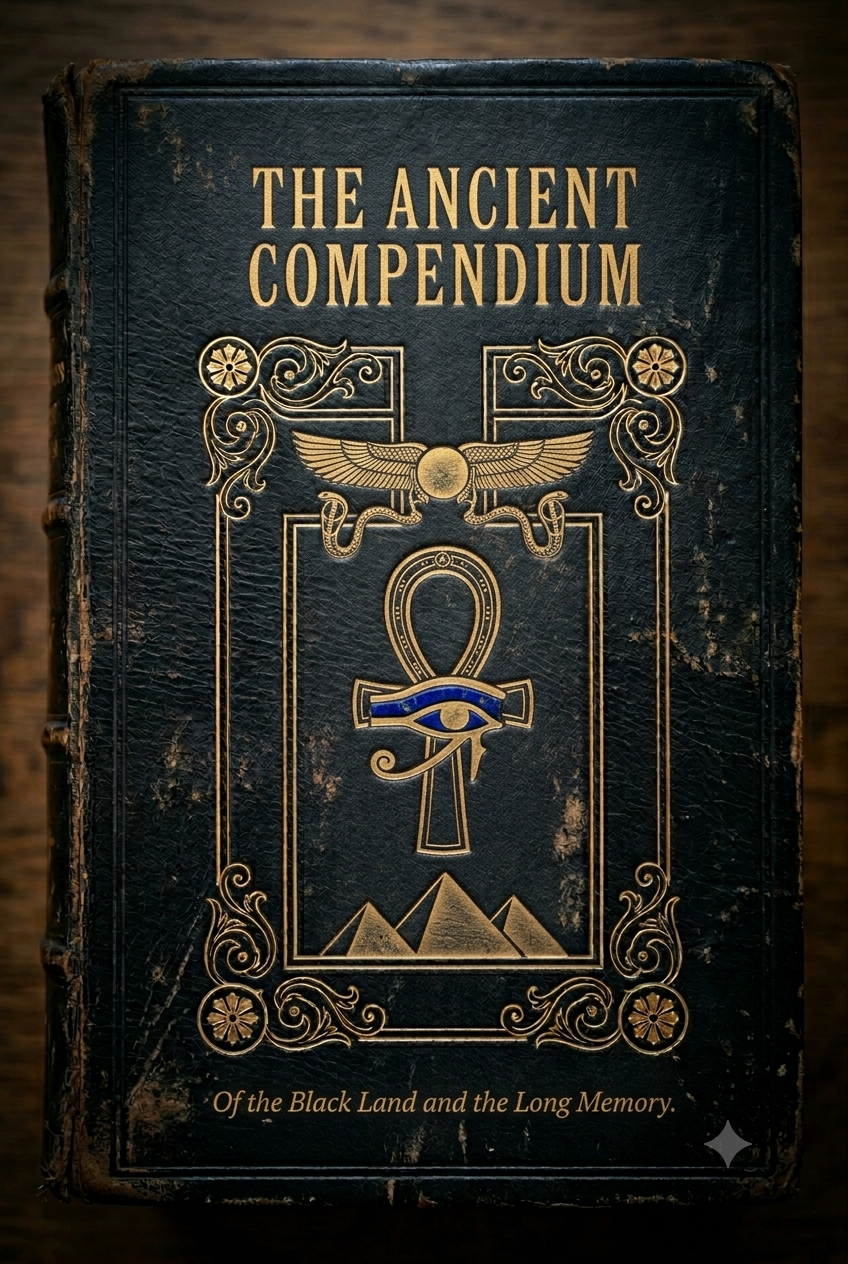
A book about the Black Land — the people who watched the Nile rise for thirty centuries, the gods they kept company with, the symbols they pressed into stone, the tombs they built against the desert, and the long road by which their teaching travelled out into every magical literature the West has ever read.
The teaching held here is older than any of the names this book uses to point at it. The Egyptians called their land Kemet, the Black Land — for the soil the Nile left behind every year, the soil that grew the grain that fed the kingdom. They called their writing medu netjer, the words of the god. They called the cosmic order Maat, and they understood the order as a goddess who could be served and as a feather against which the heart was weighed. Three thousand years of dynastic record and many more of memory before that. A civilisation slow enough to forget nothing.
And then, in the centuries of the Greek and Roman drift, that civilisation poured itself out into the world. Pythagoras went to Egypt; the Pythagoreans were trained there. Plato went; the Timaeus sounds like it. Plotinus learned there. Apollonius walked through. The Greeks who settled in Alexandria built the Library and the Mouseion, translated, argued, fused. Out of Alexandria came the Hermetic Corpus — Egyptian metaphysics in Greek dress, attributed to Thoth-Hermes-Trismegistus. Out of Alexandria came the Papyri Graecae Magicae — the Greek-Egyptian operative magic that became, by inheritance, the bedrock of Western magical literature. Out of Alexandria, in time, came everything the Renaissance occultists studied; everything the Golden Dawn revived; everything Crowley met in a Cairo flat in the spring of 1904.
This book is for any reader who wants the whole of that long road — the original civilisation, the names, the symbols, the rites, the kings, the architecture, the magic, the secret rites that kept rulers in power, the bloodier corners that most modern books smooth over, the heterodox fringe that most academic books refuse to name, the modern reception that draws on the lot. The reader who wants the Black Land entire, in one volume, in plain English, with its echoes in their own tongues.